Local SEO for Kerala Businesses: The Complete Guide to Showing Up When Customers Search Near You | Ad Touch
Most Kerala businesses lose customers to competitors who simply show up first on Google. Here's the complete guide to local SEO — from Ad Touch, Trivandrum.
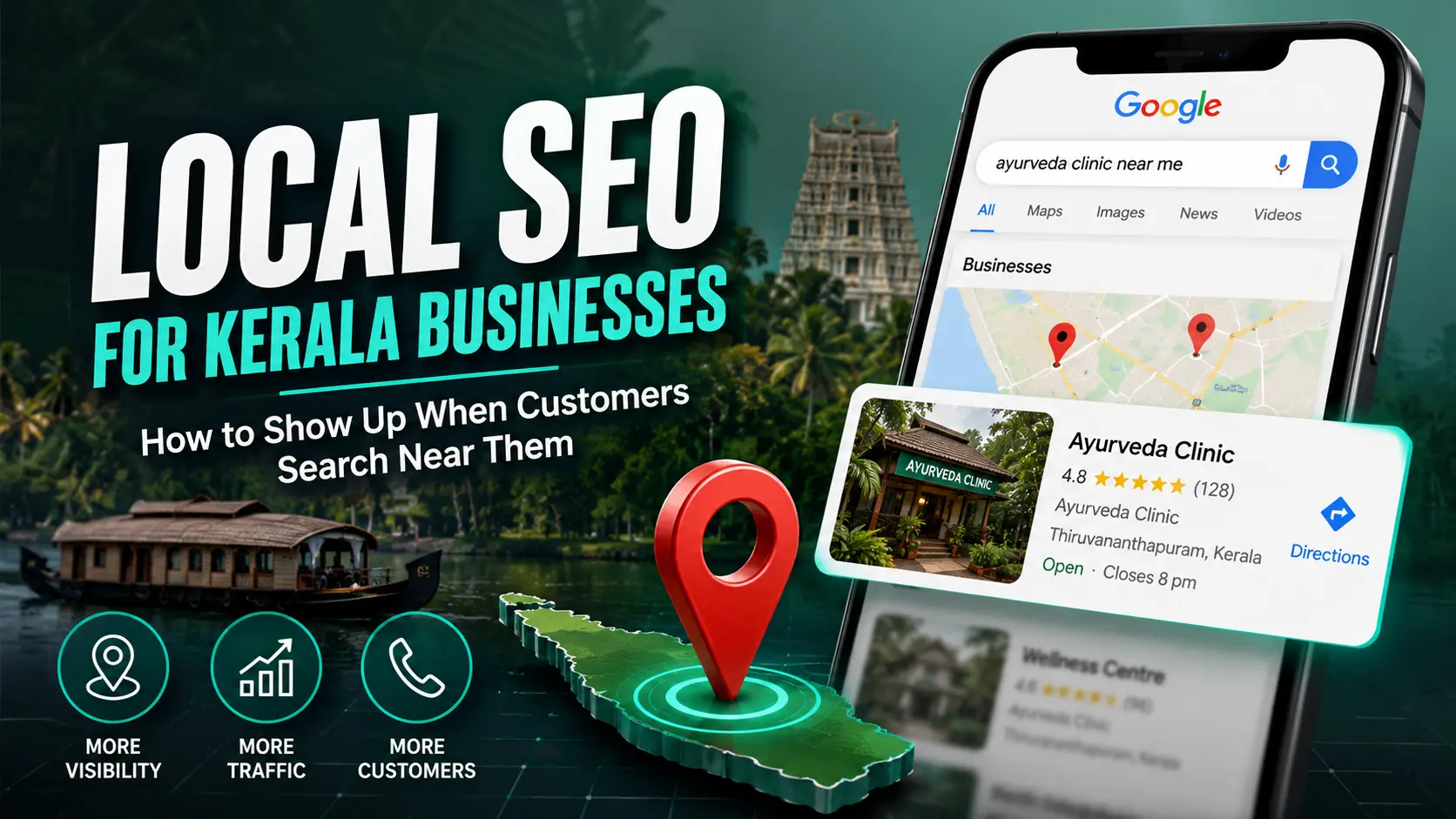
If someone in Thiruvananthapuram searches "ayurveda clinic near me" or "best institute for NEET coaching in Trivandrum" right now, is your business one of the names that shows up — or is it a competitor's?
For most small and mid-sized businesses in Kerala, it's the competitor. Not because their service is better, but because their Google presence is stronger. That's what local SEO fixes, and it's usually the fastest, most affordable way to get in front of customers who are already actively looking for what you sell — not people you have to convince, people who are ready to walk in or call.
This guide covers what local SEO actually is, why it matters more in Kerala's market than most business owners realise, exactly what to fix first in order of impact, how it plays out differently across industries, and what to expect once you start.
What Local SEO Actually Means
Local SEO is the set of steps that help your business show up in three places:
- The Google Maps "3-pack" that appears above regular search results for local queries
- Local organic search results when someone adds a place name ("near me," a locality, or a city)
- Google Maps itself, when customers are actively looking for directions or comparing nearby options
It's different from general SEO because Google isn't just trying to rank your website — it's trying to rank your business as a real, trustworthy, physically-locatable place that people can visit, call, or order from. That means signals like your address consistency, your reviews, your business hours accuracy, and even how far you are from the searcher all factor into whether you appear, alongside the more familiar signals like content and backlinks. Our SEO services at Ad Touch are built specifically around this combination.
Why This Matters More in Kerala Than You'd Think
Kerala has unusually dense local competition in almost every category — clinics, coaching institutes, boutiques, real estate agencies, and food brands are often clustered within a few kilometres, sometimes on the same road. When search intent is this local and this competitive, the business with the strongest Google presence — not necessarily the best product or the lowest price — gets the enquiry.
"A clinic with excellent care but a thin, outdated Google Business Profile consistently loses walk-ins to a nearby clinic that simply looks more active, more reviewed, and more 'alive' online."
We see this pattern repeatedly across the industries we work in at Ad Touch: hospitality, ayurveda and wellness, education and coaching, real estate, and retail. An institute with strong faculty and results still gets outranked by a newer competitor that answers Google's questions better.
The uncomfortable truth: customers rarely scroll past the first three map results or the first page of search. If you're not there, you're often not even considered — regardless of how good your business actually is.
There's also a Kerala-specific dynamic worth naming directly:
Word-of-mouth used to be the dominant discovery channel here, and for many business owners it still feels like the main one. But the first thing a person does after hearing a recommendation — from a relative, a neighbour, a colleague — is now to search the name on Google before acting on it. If what they find is a bare listing with no reviews, no photos, and an address that doesn't quite match what they were told, that referral quietly falls through. Local SEO isn't replacing word-of-mouth in Kerala; it's what determines whether word-of-mouth actually converts.
How Kerala Customers Actually Search
Before fixing anything, it helps to understand the search behaviour you're optimising for. Local searches in Kerala typically fall into a few patterns:
"Near me" searches
"Pharmacy near me," "gym near me" — done almost entirely on mobile, often with location services on.
Locality-specific searches
"Wedding photographer Kowdiar," "real estate Kazhakkoottam" — where the person already knows roughly where they want to buy or visit.
Comparison searches
"Best [service] in Trivandrum" — where reviews, ratings, and photos become the deciding factor between three or four similar-looking options.
Malayalam-English mixed queries
Increasingly common on mobile, where the business category and city name stay in English but qualifiers get typed in transliterated Malayalam.
Question-style searches on AI and voice
"Which ayurveda hospital in Trivandrum is good for back pain" — typed into Google's AI Overviews or asked by voice, where the answer engine picks a small handful of businesses to actually name.
That last pattern — AI and voice search — is growing quickly and works differently from traditional search. It rewards businesses with clear, structured information (schema markup, detailed service pages, consistent reviews). If your Google presence isn't built to answer these specific patterns, you're invisible to a meaningful share of your local market, even if your website itself is technically fine.
The Five Things That Actually Move the Needle
1. Claim and Completely Fill Out Your Google Business Profile
This is the single highest-leverage fix, and most businesses do it halfway. Business name, primary and secondary categories, complete service list, accurate hours (including holidays), service area, and a genuine phone number all need to be filled in — not just claimed and left mostly empty.
Photos matter more than owners expect
Profiles with 20+ recent, real photos consistently outperform profiles with five old ones. Google reads photo activity as a signal that the business is active.
Google Business Posts are a ranking signal
Businesses that post even once every couple of weeks look noticeably more active, and that activity itself signals to Google that you're a live, engaged listing.
This applies especially to hospitality, food, and wellness businesses, where customers decide almost entirely on visuals before they ever visit.
2. Keep Your NAP Consistent Everywhere
NAP stands for Name, Address, and Phone number. These three details need to match exactly across your website, Google Business Profile, Justdial, Sulekha, Facebook, Instagram, and any directory you're listed on. Small inconsistencies quietly confuse Google's confidence in your business — and confidence directly affects ranking.
This is one of the most common issues we find during audits: businesses that have grown organically over several years often have three or four slightly different address formats floating around the internet from old listings nobody remembers creating. It's also common to find an old landline number still listed somewhere long after the business moved entirely to mobile — a small detail that quietly costs enquiries.
3. Build Location-Specific Content on Your Website
A generic homepage that never mentions your city, locality, or service area gives Google very little to work with. Pages that clearly and naturally state their location rank for the exact searches your customers type. This is where a properly built website with a thoughtful content strategy makes a measurable difference.
This goes beyond the homepage. Service pages, location pages (if you operate in more than one area), and even blog content should reinforce where you operate and who you serve, in language that matches how real customers search. A business with three branches across Kerala sees meaningfully better results from three distinct, locally-written pages than from one page that lists all three addresses at the bottom.
4. Collect and Respond to Reviews Consistently
Review volume and recency are direct ranking factors, not just trust signals for the customer reading them. A steady stream of new reviews — arriving weekly or monthly — consistently outperforms a business with fifty old five-star reviews and nothing new in the last year.
Responding to every review, positive or negative, also matters. It signals an active, attentive business, and gives you a chance to publicly and professionally address any negative feedback. Businesses that build a simple habit of asking satisfied customers for a review right after service — a message, a QR code at the counter, a follow-up WhatsApp — see this compound significantly over a few months.
This is also where local SEO overlaps directly with online reputation management: how you handle a bad review publicly often matters more to a prospective customer than the review itself.
5. Fix the Technical Basics
These quietly suppress rankings even when everything else is done right — and this is usually the part business owners don't know to check, because the website "looks fine" to them. But Google is evaluating things they can't see: page speed scores, structured data, mobile usability, and crawlability.
This is where local SEO and web development overlap. In Kerala, a large share of local searches happen on mobile data rather than Wi-Fi — a slow-loading site loses the customer before it even finishes rendering.
How Local SEO Plays Out Differently by Industry
The fundamentals above apply everywhere, but the priorities shift depending on what you run.
Hospitality (Hotels, Resorts, Spas)
Photos and reviews carry disproportionate weight, since guests are booking based almost entirely on visual trust before they arrive. Recent, high-quality photos of rooms, amenities, and the actual property beat professionally shot but outdated images. Review responses matter enormously here, since prospective guests often read them specifically looking for how complaints were handled.
Education & Coaching Institutes
Location-specific landing pages for each course or programme (NEET, JEE, IELTS, spoken English) tend to outperform a single generic 'courses' page, since parents and students often search by course name plus locality rather than by institute name. Results and outcomes, where genuinely available, belong prominently on these pages.
Ayurveda & Wellness Clinics
Trust signals matter more here than almost anywhere else — practitioner credentials, treatment-specific pages, and detailed specific reviews all influence both rankings and conversion. Many searches here are symptom-led ("treatment for joint pain Trivandrum") rather than brand-led, so content built around specific conditions and treatments performs well.
Real Estate
Locality-specific pages are essential, since buyers search almost exclusively by area name plus property type ("2BHK flats Kazhakkoottam"). Fresh listings and regularly updated content signal activity to both Google and the buyer.
Retail, F&B & D2C Brands
Google Business Profile posts and photo freshness matter most, since these businesses see high volumes of quick "is it open now / what do they have" type searches. Accurate hours, especially around holidays and festivals, directly affects walk-in traffic.
Common Mistakes We See Across Kerala Businesses
- Treating the Google Business Profile as a one-time setup instead of something that needs ongoing posts, photo updates, and review responses
- Using a P.O. box or a vague "service area" listing when a real, verifiable address would rank significantly better
- Duplicate or fake listings created years ago by an old employee or agency, still live and competing against the real profile
- Ignoring negative reviews instead of responding professionally, which both hurts trust and signals inactivity to Google
- Websites with no mention of the city or locality anywhere in the text, relying purely on the business name to convey location
- Inconsistent business hours between the website and Google, which erodes trust when a customer arrives to find a locked shutter
- Chasing rankings in areas the business doesn't actually serve, which wastes effort and can violate Google's guidelines on service-area listings
How Long Before You See Results
Local SEO isn't instant, but it's also not as slow as people often assume. Profile completeness and listing consistency fixes can show measurable movement within a few weeks. Content, review velocity, and authority-building typically compound over two to three months and continue improving from there.
The businesses that treat local SEO as an ongoing habit — not a one-time project — are consistently the ones that stay on top, because their competitors usually give up after the first round of fixes.
It also helps to set the right expectation internally: local SEO rarely produces a single dramatic jump. It's a steady accumulation of small, correct signals — a filled-out field here, a fresh review there, a locally-written page somewhere else — that together shift how confidently Google recommends you.
A Simple Starting Checklist
If you want to get a sense of where you stand before bringing in help, start here:
If two or more of these reveal a gap, that's usually where the biggest, fastest wins are hiding.
Frequently Asked Questions
Do I need a website if I already have a Google Business Profile?
Yes. A profile alone can generate calls and direction requests, but it can't build the deeper trust, service detail, or content depth that a proper website does — and profiles without a linked, working website consistently rank lower than those with one.
Can I do local SEO myself, or do I need an agency?
The basics — claiming your profile, fixing NAP consistency, asking for reviews — are things any business owner can start today. Where it usually needs expert help is in technical fixes, structured content strategy across multiple pages or locations, and staying current as Google's local and AI search algorithms change.
How much does local SEO cost in Kerala?
It varies widely based on how many locations, how competitive your category is, and how much needs fixing. What matters most is starting with an honest audit rather than a fixed package, so you're paying for what your business actually needs.
Does local SEO help with AI search tools like Google's AI Overviews?
Increasingly, yes. The same signals — accurate structured data, detailed and specific content, consistent reviews — that help you rank in traditional local search also make it more likely that AI-generated answers mention your business by name.
How is local SEO different from regular SEO?
Regular SEO focuses on ranking your website globally or nationally for keywords. Local SEO focuses on ranking your business as a physical location for searches in a specific geography — it uses entirely different signals like your Google Business Profile, NAP consistency, proximity, and local review volume.
Where to Start
If you're not sure where your business currently stands, the simplest first step is a proper audit — what's working, what's actively hurting your visibility, and what to fix first, in priority order.
That's exactly how we begin every SEO engagement at Ad Touch — a full audit of your Google presence, website, and competitors before we recommend a single change, followed by a clear strategy built around your specific goals rather than a generic checklist.
Want to know exactly where your business stands in local search right now?
Get a free consultation with our team in Trivandrum, or explore our SEO services to see how we approach it from audit to results.
Free Consultation